The Vagus Nerve, Breath, and the Architecture of Stress Recovery
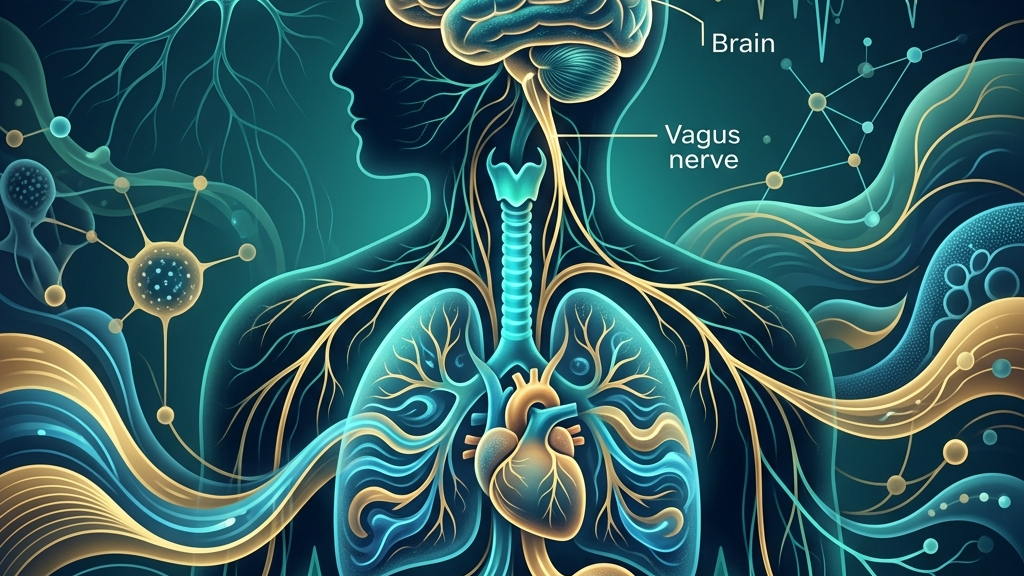
How the vagus nerve works
The vagus nerve, designated as cranial nerve X, extends from the brainstem through the neck and into the chest and abdomen, forming the longest cranial nerve in the body. It carries both sensory information from visceral organs back to the brain and motor signals that help regulate involuntary processes such as heart rate, digestion, and respiration. As the chief parasympathetic pathway, it promotes the “rest-and-digest” mode that counters the sympathetic activation associated with immediate threat responses, allowing the body to conserve energy and restore balance once a stressor has passed. One of its most measurable expressions appears in heart-rate variability, the natural fluctuation in time between heartbeats. Higher variability often reflects stronger vagal influence, indicating that the heart can flexibly respond to changing internal and external demands. Research on cardiac vagal tone highlights how this variability serves as a window into autonomic flexibility rather than a fixed trait. The nerve also participates in the gut-brain axis, transmitting signals from enteroendocrine cells and microbiota that can influence mood, satiety, and inflammatory tone through both afferent and efferent fibers. Anatomically, the vagus nerve branches extensively, with nuclei in the medulla that coordinate swallowing, speech, and parasympathetic outflow to the lungs and gastrointestinal tract. Sensory neurons within these pathways monitor stretch, chemical composition, and mechanical pressure, feeding data upward that shapes subsequent regulatory adjustments. This continuous feedback loop supports the nerve’s role in modulating inflammation via the cholinergic anti-inflammatory pathway, a mechanism that has drawn attention in studies of systemic immune responses. For instance, vagal afferents detect changes in stomach wall tension after a meal, relaying volume and nutrient data that prompt the brainstem to adjust insulin release and intestinal motility in real time. In everyday settings, this same circuitry registers the difference between a hurried breakfast eaten while standing and a seated meal consumed slowly, with the latter typically producing steadier afferent traffic that favors sustained parasympathetic engagement.The Vagus Nerve in Recovering from Stress
Stress activates sympathetic pathways that increase heart rate, redirect blood flow to skeletal muscles, and suppress non-essential functions such as digestion. The vagus nerve contributes to the counterbalancing process by re-engaging parasympathetic tone, gradually lowering heart rate and restoring gastrointestinal motility once the perceived threat diminishes. This transition is sometimes described as releasing the “vagal brake,” allowing the cardiovascular system to decelerate efficiently rather than remaining in an elevated state. Physiologically, vagal afferents from the heart and lungs convey information about blood pressure and respiratory status to brainstem centers that then adjust efferent output. When vagal tone is robust, recovery tends to occur more smoothly, with heart rate returning toward baseline and inflammatory markers potentially stabilizing. Studies examining heart-rate variability after acute stressors show that individuals with greater baseline vagal activity often exhibit faster normalization of autonomic parameters, though individual differences in genetics, prior stress exposure, and overall health status introduce considerable variability. People commonly notice shifts in digestion, such as renewed appetite or normalized bowel patterns, as vagal signaling to the enteric nervous system resumes. Some report a subjective sense of mental clarity or reduced muscle tension once parasympathetic dominance is re-established. These observations align with the nerve’s widespread projections but remain subjective experiences rather than universal markers. After an intense work deadline, for example, the return of peristaltic waves in the intestines may coincide with the first comfortable deep breath taken without conscious effort, illustrating how vagal efferents re-establish coordinated organ function once cortical threat appraisal declines. Prolonged or repeated stress can dampen vagal responsiveness over time, a phenomenon linked in research to lower heart-rate variability and slower physiological recovery. The vagus nerve does not operate in isolation; it interacts with other cranial nerves and hormonal systems, so recovery trajectories reflect this broader network. Understanding these dynamics helps explain why some individuals experience lingering physical sensations after stress even when the original trigger has ended. Subtle changes in baroreceptor sensitivity, for instance, may leave the cardiovascular system slightly less responsive to the next mild challenge, such as climbing stairs shortly after an argument.How Breathing Patterns Engage the Vagus Nerve
Breathing directly influences vagal activity through mechanical and neural routes. During inhalation, heart rate typically rises slightly; during exhalation, it falls—a pattern known as respiratory sinus arrhythmia that is partly mediated by vagal efferents to the sinoatrial node. Extending the exhale tends to amplify this oscillation, increasing the amplitude of heart-rate variability and thereby reflecting heightened vagal engagement at that moment. The vagus nerve’s pulmonary and laryngeal branches carry sensory feedback from lung stretch receptors and airway pressure, which the brainstem integrates to fine-tune both respiratory rhythm and cardiac output. Slow, rhythmic breathing at approximately six breaths per minute often maximizes this coupling, though the precise rate varies with age and fitness. This respiratory modulation occurs without conscious effort in quiet states yet can be consciously shaped, illustrating the nerve’s dual role in automatic and volitional control. Individuals sometimes observe that deliberate breathing practices coincide with a subjective calming of mental activity or a reduction in perceived chest tightness. These reports correspond to measurable shifts in vagal tone during the practice itself, although the duration of any carry-over effect differs widely. Because breathing also influences cerebral blood flow and carbon dioxide levels, the overall experience involves multiple overlapping systems beyond the vagus alone. A person sitting in traffic may notice that lengthening the exhale by two or three seconds produces a detectable softening of jaw tension within a single minute, reflecting momentary enhancement of vagal cardiac inhibition. Chronic alterations in breathing patterns, such as those associated with anxiety or restricted diaphragmatic movement, can reduce the natural respiratory sinus arrhythmia that supports vagal tone. Conversely, restoring smoother, slower breathing rhythms may gradually enhance the nerve’s regulatory capacity through repeated stimulation of its afferent pathways. The relationship remains bidirectional: improved vagal function can in turn support more stable breathing, creating a feedback loop that research continues to map in both healthy and clinical populations. Over weeks, someone who habitually sighs or holds the breath during concentration may find that the same tasks elicit less frequent interruptions once diaphragmatic excursions become more consistent.What the research shows
Large-scale anatomical reviews confirm that the vagus nerve constitutes the primary parasympathetic supply to thoracic and abdominal viscera, with extensive sensory innervation that underpins its regulatory functions. Cleveland Clinic descriptions of vagus nerve anatomy emphasize its mixed sensory-motor composition and its distribution through the neck and torso. Complementary neuroanatomical detail appears in NIH StatPearls coverage of cranial nerve 10, which outlines brainstem nuclei and peripheral branching patterns relevant to autonomic control. Investigations into heart-rate variability position cardiac vagal tone as a key index of autonomic flexibility, with lower variability frequently observed after sustained stress exposure. Research on heart rate variability and cardiac vagal tone synthesizes evidence linking these metrics to broader health indicators without establishing direct causation. Parallel work on the gut-brain axis demonstrates that vagal sensory neurons relay microbial and mechanical signals from the intestine, influencing central processing of interoceptive information. Studies of the vagus nerve as modulator of the brain–gut axis and examinations of vagal sensory neurons and gut–brain signaling together illustrate the volume and specificity of this afferent traffic. Additional findings connect vagal pathways to sleep architecture. Work on vagus nerve stimulation, sleep-disordered breathing, and sleep quality explores how altered vagal signaling may intersect with respiratory stability during rest, though results vary across populations and stimulation parameters. Collectively, these sources portray the vagus nerve as an integrative hub rather than a single switch, with effects that emerge through distributed networks and are shaped by context, duration, and individual physiology.Practical ways to support your vagus nerve
- Slow extended exhales performed for a few minutes while seated can accentuate respiratory sinus arrhythmia and momentarily increase heart-rate variability by enhancing vagal outflow to the heart.
- Gentle humming or soft gargling stimulates laryngeal branches of the vagus through vibration and may produce a brief sense of throat relaxation tied to parasympathetic activation.
- Brief, tolerable cold exposure such as cool water on the face activates trigeminal and vagal afferents that can shift autonomic balance toward parasympathetic dominance during the exposure.
- Paced breathing at roughly six breaths per minute, with longer exhales, engages pulmonary stretch receptors and maximizes the coupling between respiration and cardiac rhythm mediated by the vagus.
- Light rhythmic movement such as walking at a comfortable pace promotes mechanical stimulation of visceral afferents along vagal pathways while avoiding excessive sympathetic drive.
- Consistent morning light exposure combined with stable sleep timing helps entrain circadian rhythms that indirectly support autonomic regulation, including vagal modulation of cardiovascular and gastrointestinal function.
When to talk to a professional
Certain symptoms warrant prompt medical evaluation regardless of any interest in vagal pathways. Sudden changes in heart rhythm, severe shortness of breath, persistent chest pain, or unexplained fainting should be assessed by a clinician to rule out cardiac or neurological conditions. Likewise, abrupt alterations in swallowing, persistent hoarseness, or one-sided facial weakness merit examination because they can reflect cranial-nerve involvement that requires diagnostic clarification. Chronic digestive disturbances, significant sleep disruption, or mood changes that interfere with daily functioning also justify professional consultation. These presentations may have multiple contributing factors, and only a qualified practitioner can determine appropriate next steps. Self-directed exploration of breathing or movement practices is not a substitute for such evaluation when symptoms are intense or rapidly evolving.Common questions
Does everyone have the same level of vagal tone?
Vagal tone varies considerably across individuals due to genetics, age, fitness, and life history; no single measurement captures a universal “normal” value, and day-to-day fluctuations are expected.
Can breathing changes affect the vagus nerve quickly?
Respiratory patterns can produce immediate, measurable shifts in heart-rate variability during the practice itself, though longer-term adaptations depend on consistency and broader physiological context.
Is heart-rate variability the only marker of vagal function?
While heart-rate variability offers a convenient noninvasive window, vagal activity also influences gastrointestinal motility, inflammatory tone, and laryngeal function, so a full picture requires multiple indicators.
Do stress-recovery effects appear immediately after breathing exercises?
Some autonomic shifts can be detected within minutes, yet subjective recovery experiences differ widely and are influenced by the nature of the preceding stressor and overall health status.
The vagus nerve’s connections between breath and stress recovery illustrate a fundamental regulatory architecture that operates continuously beneath conscious awareness. Appreciating its anatomy and the evidence surrounding its functions provides a framework for noticing patterns in one’s own physiology without overinterpreting isolated sensations. Continued research will refine these understandings, yet the existing literature already underscores the value of attending to autonomic flexibility as one dimension of overall well-being.Have a question?
Have a question about something specific? Send us a message.
Visit VagusSkool.com/contact — we'll try to get back to you within 24 hours.